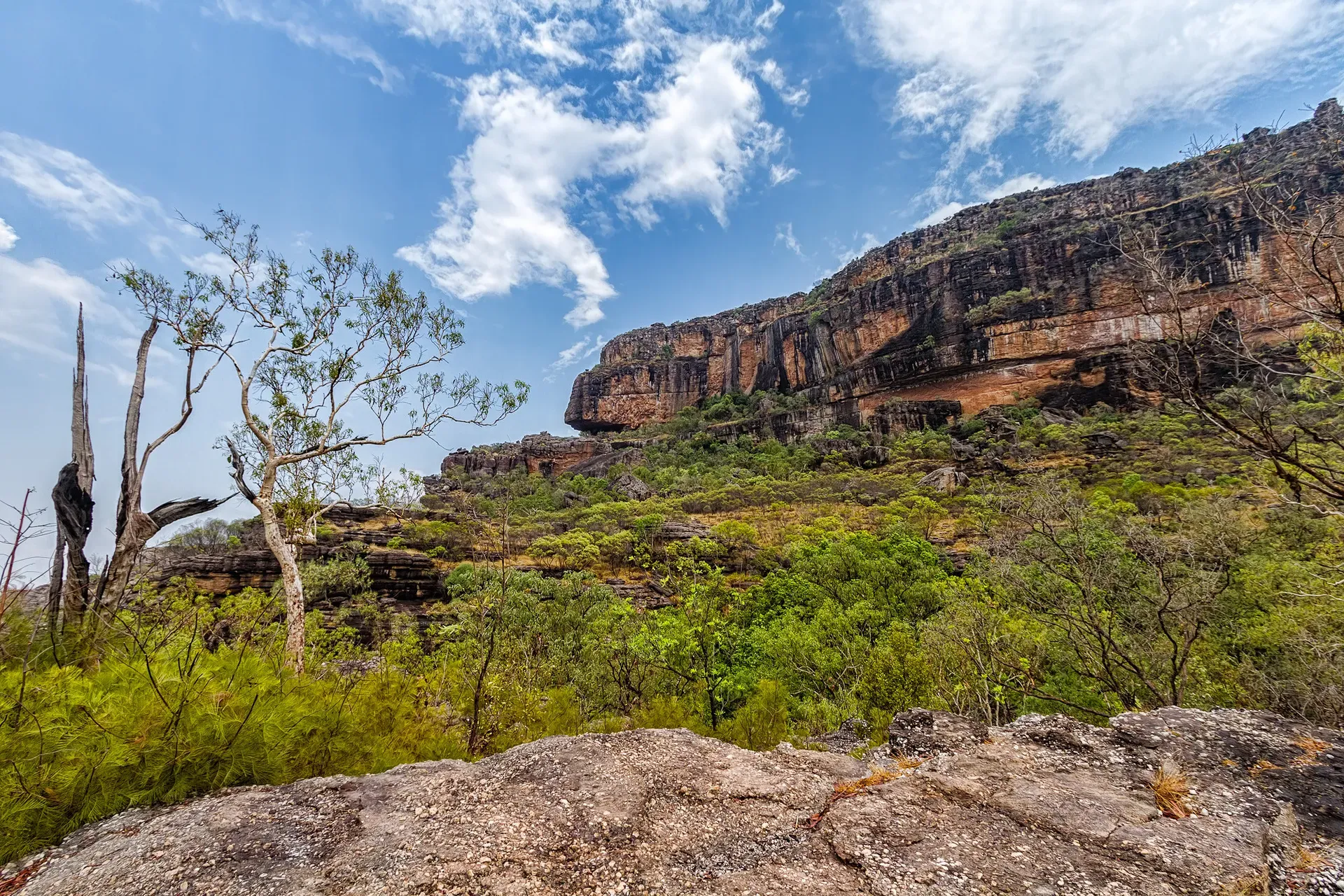
Kakadu hands you four real choices: a hotel bed in Jabiru, a lodge room at Cooinda, a wilderness camp on the Mary River floodplains, or a swag at a bush campground under the stars. That's about it. This is a park almost the size of Switzerland, and its accommodation is squeezed into two small towns and a scatter of campgrounds, so the base you pick shapes which waterfalls, cruises and rock art sites end up within easy reach.
Most visitors book at least three nights, and Parks Australia's own visitor guide recommends three to five days to see the park properly. Anything shorter and you're really choosing one region and skipping the rest. This guide covers where to base yourself, what each property costs, and when to lock in a booking before the dry season fills up. For what to do once you've settled on a base, see our guide to things to do in Kakadu.
Quick Answer: Where Should You Stay in Kakadu?
Cooinda is the default pick for most itineraries. It sits on Yellow Water Billabong, puts the cruise, Nourlangie and the Jim Jim/Twin Falls turnoff all within reach, and has a hotel wing, glamping tents and a caravan park on one property. Jabiru works better if you want a supermarket, fuel, a bank and quick access to Ubirr and Cahills Crossing on the East Alligator River. Neither rules out the other: the two towns are under an hour apart on sealed road, and plenty of trips split a stay between them.
- Families and first-timers: Cooinda, central and closest to the Yellow Water cruises.
- Full-service base: Jabiru, the park's only town, near Ubirr.
- Luxury and wildlife: Mary River wilderness lodges just outside the park.
- Budget: national park campgrounds, roughly $15 a night.
- Trip length: book 3 nights minimum, 4-5 for the full waterfall circuit.
Choosing Your Base: Jabiru, Cooinda, Mary River & Beyond
Kakadu's accommodation clusters around three points, and each one puts a different slice of the park at your doorstep.
Jabiru
Jabiru is the only town inside Kakadu, with a supermarket, fuel station, bank and small airstrip. It's the practical base for reaching Ubirr's rock art galleries and Cahills Crossing on the East Alligator River, both a short drive north-east, and it works well if you'd rather stock up on supplies than rely on a single lodge kitchen. The Mercure Kakadu Crocodile Hotel, Anbinik Kakadu Resort and Aurora Kakadu Lodge all sit in or near town, which gives Jabiru the widest spread of prices of any single hub in the park.
Cooinda & Yellow Water
Cooinda sits on the bank of Yellow Water Billabong and is the closest accommodation to the Yellow Water cruises, the wetland boat trips that put you close to crocodiles, jabiru storks and thousands of waterbirds. It's also the most central base in the park: Nourlangie's rock art is a short drive away, and the turnoff to Jim Jim and Twin Falls is close enough to make a dry-season day trip realistic, details worth checking against our Kakadu waterfalls guide before you plan a route. Cooinda Lodge is the only accommodation on site, but it covers hotel rooms, glamping tents and a caravan park under one roof, so it suits almost any budget without changing location.
Mary River & Cannon Hill
The Mary River floodplains, just outside Kakadu's boundary, hold the park's most remote and highest-end lodges. Bamurru Plains sits on a working buffalo station on the floodplain, while Hawk Dreaming Wilderness Lodge occupies Cannon Hill inside the park, with access to restricted rock art sites few other visitors ever reach. Both trade convenience for isolation. Expect a longer drive and a guided, all-inclusive itinerary rather than a self-drive base for day-tripping to the main sights.
Self-driving from Darwin via the Arnhem Highway takes about 2-3 hours to reach Jabiru and 3-4 hours to Cooinda, all on sealed road in the dry season. Our directions and transport guide covers the full route, or book a seat on a tour from Darwin if you'd rather skip the driving altogether.
Hotels, Lodges & Resorts (Comfort to Luxury)
Kakadu's serviced accommodation is limited to a handful of named properties, so it pays to know what each one actually offers before you book.
Cooinda Lodge
Cooinda Lodge has 48 refurbished hotel rooms with ensuites, plus 20 Outback Retreat glamping tents with air conditioning and private verandas, sized for doubles and families. Rates span roughly AU$129 to $1,699 a night depending on room type and season, with the hotel rooms at the lower end and the premium tents and family villas at the top. It's the only accommodation directly on Yellow Water Billabong, with a bar, restaurant and pool on site, and it's the pick for anyone prioritising the cruise and the southern waterfalls over remote luxury.
Mercure Kakadu Crocodile Hotel
Built in the shape of a crocodile, best appreciated from the air, this Jabiru hotel is Kakadu's most conventional stay: air-conditioned rooms, a restaurant, a bar and a pool, with rates running roughly $185 to $685 a night. It suits travellers who want a familiar hotel experience with Ubirr and Cahills Crossing a short drive away, rather than a wilderness-lodge atmosphere.
Anbinik Kakadu Resort
Anbinik is Jabiru's budget option, with bush bungalows, cabins and suites priced from about $62 to $370 a night. It's the spot for families or groups who want a private room without lodge prices, and the range stretches from basic bungalows up to more comfortable ensuite cabins.
Aurora Kakadu Lodge
Aurora Kakadu combines motel-style cabins with a full caravan park on the same site, giving self-drivers the choice of a room or a powered site without changing location. It's a practical middle ground for families travelling with a caravan who still want a fallback room if the weather turns.
Bamurru Plains
Bamurru Plains has 9 stand-alone safari bungalows spread across a 300-square-kilometre working buffalo station on the Mary River floodplains, just outside the park. All meals and drinks are included in the rate, and the property runs its own airboat and 4WD wildlife trips rather than sending guests into the park for tours. It's built for travellers who want a genuine safari-lodge experience and don't mind paying for it.
Hawk Dreaming Wilderness Lodge
Hawk Dreaming is sold as a 3-day guided package through Kakadu Cultural Tours rather than a stand-alone room booking, with two nights in tented cabins at Cannon Hill, sunset tours, a 4WD day tour and a Guluyambi cruise included. Access to the surrounding rock art sites is restricted to guests on this package, which makes it the choice for travellers who want guided cultural depth over a self-drive itinerary.
Camping & Caravan Parks (Private and National Park)
Camping in Kakadu splits into three distinct tiers, and mixing them up is the easiest planning mistake to make.
Private caravan parks
Cooinda's Ngurrungurrudjba (Yellow Water) Campground & Caravan Park, Aurora Kakadu Lodge and Anbinik Kakadu Resort all run powered sites with full facilities: showers, laundries, camp kitchens and often a pool. The Yellow Water Campground ranges from roughly $29 to $129 a night depending on site type, from an unpowered tent site to a powered ensuite site. These are the ones to book ahead in the dry season. Unlike national park campgrounds, they take reservations, and they do sell out.
Managed national park campgrounds
Merl, Muirella Park, Mardugal and Gunlom are Parks Australia's managed campgrounds, with flush toilets and solar-powered showers for around $15 a night. None of them take bookings; sites are first-come, first-served, so arriving early in peak season, particularly at Gunlom, matters more than any reservation ever would.
Basic bush campgrounds
Sites like Alligator Billabong and Four Mile Hole sit at the bottom of the ladder: 4WD-only access, no toilets, no drinking water, little more than a flat patch of ground and a fire ring. They cost nothing beyond the park pass itself, though camping outside these designated campgrounds, off-track bush camping, requires a separate permit from Parks Australia.
What Kakadu Accommodation Costs: A Budget Comparison
Lay every tier side by side and the range runs from free to well over a thousand dollars a night.
| Accommodation tier | Price per night (AUD) | What you get |
|---|---|---|
| Free bush campground | Free (park pass only) | No toilets, no drinking water, 4WD access only |
| National park campground | Around $15 | Flush toilets, solar-powered showers |
| Private caravan park (powered site) | $29-$129 | Powered sites, camp kitchen, full facilities |
| Budget cabin/resort room | $62-$370 | Ensuite bungalows up to family suites |
| Mid-range hotel | $185-$685 | Full-service hotel, pool, restaurant |
| Top-tier lodge/glamping | Up to $1,699 | Premium glamping, villas, all-inclusive lodges |
None of those figures include the park pass, which is compulsory for every non-Territory resident and sold separately from accommodation. A 7-day pass costs $40 per adult, $20 per child (5-15), $100 per family or $30 concession during the dry season, 15 May to 31 October; rates drop to $25, $12.50, $65 and $19 respectively during tropical summer, 1 November to 14 May. That's a real saving if your trip can shift into the shoulder months. Pass revenue covers only about 7% of what it costs to run Kakadu, with the rest funded by the Australian Government. Check current fees on our opening hours and fees page before you book.
When to Book & Practical Tips
Dry season, May to October, is when Kakadu fills up. Hotel rooms, glamping tents and guided tours get booked out months in advance for the June-August school holiday stretch, so lock in Cooinda Lodge or a Jabiru hotel as soon as your dates are set.
Tropical summer, November to April, brings lower rates and thinner crowds, but roughly a third of the park can flood. Some roads, campgrounds and remote lodges close outright, and Jim Jim and Twin Falls stay shut until the tracks reopen, typically from around June or July. A scenic flight over the escarpment is often the only way to see the falls from above while the roads are closed. Check the Kakadu Access Report the morning you set out; conditions change fast.
Jabiru and Cooinda sit on sealed roads and are accessible by 2WD through the dry season. Reaching remote bush campgrounds, or driving the Jim Jim/Twin Falls track, needs a high-clearance 4WD regardless of season, and a 4WD becomes close to essential everywhere once the rains set in.
Pets aren't permitted anywhere in Kakadu, camping or hotels, to protect native wildlife. Leave them at home or with a sitter in Darwin, and for the animals you will see, our Kakadu wildlife-spotting guide covers what to expect at each site.
Frequently asked questions
How many days should I spend in Kakadu National Park?
Parks Australia recommends 3 to 5 days minimum, and most visitors book at least 3 nights of accommodation to see the main sights without rushing between them.
Is it better to stay in Jabiru or Cooinda?
Jabiru is the park's only town, with the most services and the closest access to Ubirr and Cahills Crossing. Cooinda is more central, sits on Yellow Water Billabong, and is closer to Nourlangie and the Jim Jim/Twin Falls turnoff. Many visitors split their stay between the two.
Do I need a 4WD to stay in Kakadu National Park?
No. Jabiru and Cooinda are on sealed roads and accessible by 2WD in the dry season. A 4WD is required for remote campgrounds, the Jim Jim/Twin Falls track, and much of the park once the wet season arrives.
How much is the Kakadu park pass and is it included in accommodation prices?
The park pass is bought separately from accommodation. It's $40 per adult in the dry season (15 May-31 October) or $25 in tropical summer (1 November-14 May), valid for 7 days, with family and concession rates also available.
Can you camp for free in Kakadu?
Yes. Several basic, 4WD-only bush campgrounds have no camping fee beyond the park pass, but they have no facilities, no toilets and no drinking water, unlike the roughly $15-a-night managed campgrounds.
Are pets allowed at Kakadu accommodation or campgrounds?
No. Pets are prohibited throughout Kakadu National Park to protect native wildlife, and that applies to every campground and every hotel or lodge within the park boundaries.
Do I need to book campsites in Kakadu in advance?
National park campgrounds don't take bookings and run first-come, first-served. Private caravan parks, hotels and lodges do take bookings and should be reserved well ahead for the May-October dry season peak.