
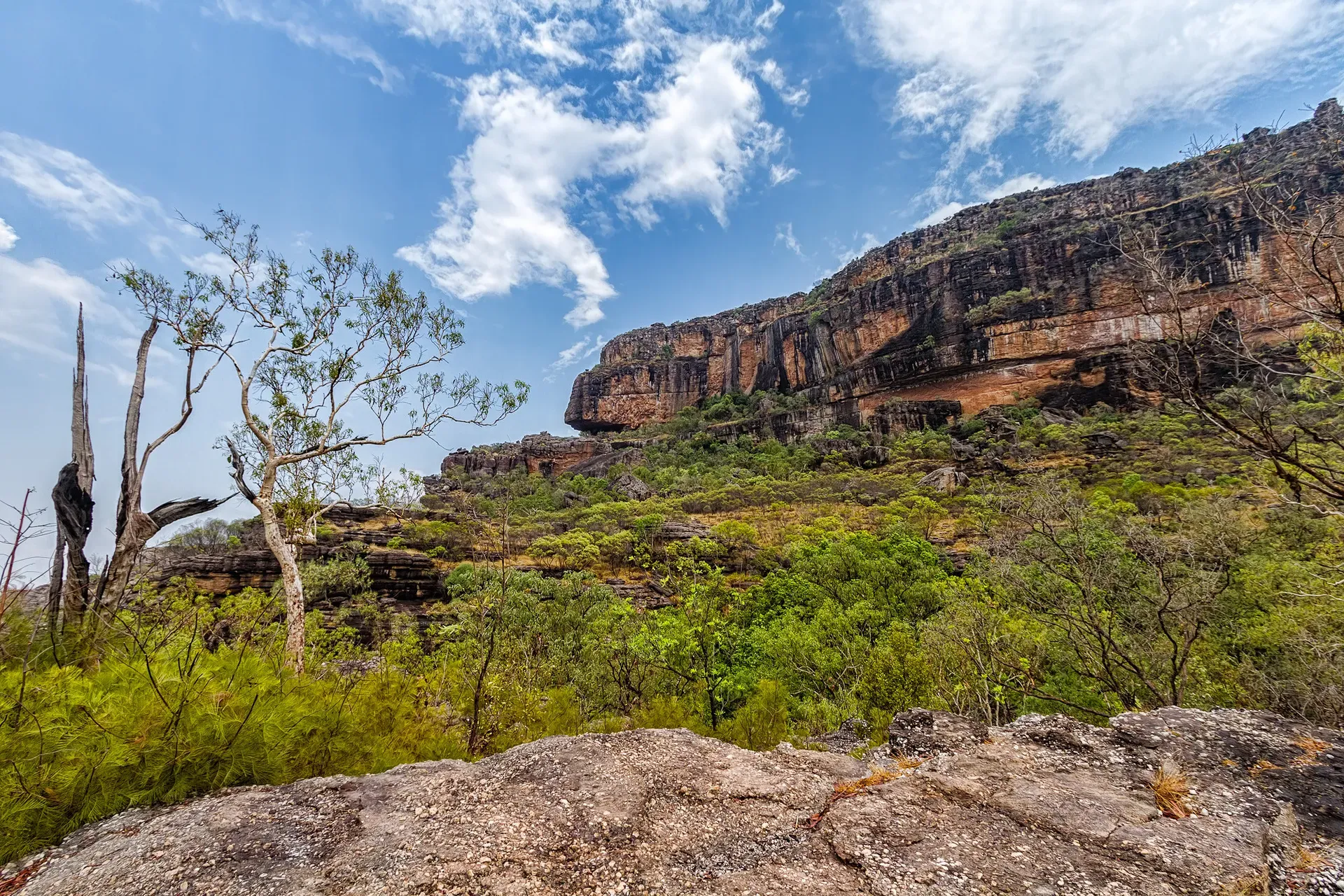
Kakadu's waterfalls split into two different trips. One is a 4WD slog down corrugated tracks to plunge pools beneath 200-metre cliffs, open only half the year. The other is a shaded, 2WD-friendly walk to a rainforest swimming hole that runs most months. Which falls you can actually reach depends on your vehicle, the season, and how many hours you're willing to spend in a car before you get wet.
This guide covers all eight named waterfalls worth knowing about, from famous Jim Jim Falls to the permit-only Koolpin Gorge, with the access, walk length and swimming rules for each. For the wider park context, see our Kakadu National Park overview.
Kakadu's Waterfalls at a Glance
Kakadu has around eight named waterfalls that are realistically visitable, scattered across almost 20,000 square kilometres of escarpment country. Four need a high-clearance 4WD, one is open to ordinary cars year-round, and two are permit-only or best done with a guide. The table below is the shortcut — match your vehicle and timeframe against it before you commit to a drive.
| Waterfall | Height | Access | Walk | Swimming | Best Season |
|---|---|---|---|---|---|
| Jim Jim Falls | 200m | 4WD only, 50km track | 1km one-way, ~3hrs return | Yes, plunge pool | Jul-Oct |
| Twin Falls | — | 4WD + shuttle boat | 6km return (plateau) or 1km (lookout) | Base pool, when boat runs | Jul-Oct |
| Gunlom Falls | 85m | 40km unsealed, 4WD recommended | Steep 15-20 min climb to upper pools | Yes, upper pools | May-Oct |
| Maguk (Barramundi Gorge) | — | 14km 4WD track | 2km return | Yes, plunge pool | May-Oct |
| Motor Car Falls | — | 2WD-friendly | 7.5km return, ~4hrs | Yes | Year-round, conditions permitting |
| Koolpin Gorge (Jarrangbarnmi) | — | 4WD + permit required | Varies | Yes, permit only | May-Oct |
Numbers aside, only Jim Jim, Gunlom, Maguk and Motor Car Falls have swimming areas checked each dry season. Twin Falls' base pool depends on the shuttle boat being open, and Koolpin Gorge needs a permit no matter when you go.
Jim Jim Falls: Kakadu's Tallest Waterfall
Jim Jim Falls drops 200 metres off the Arnhem Land escarpment, the tallest waterfall in Kakadu and taller than anything in neighbouring Litchfield or Nitmiluk National Parks. The cliffs form a natural amphitheatre around a plunge pool that stays cool even when the Top End air is stifling. It's the waterfall most people picture when they think of Kakadu, and the one that takes the most effort to reach.
Getting there means 50km of 4WD-only track off the Kakadu Highway, with deep corrugations, single-lane stretches and water crossings that rule out anything without high clearance. From the car park, the Jim Jim Plunge Pool Walk covers a rocky 1km each way, boulder-hopping over sun-baked sandstone that turns a short distance into a three-hour return trip. Visitors after an easier look can take the Viewing Pool walk instead — 800 metres, roughly an hour return, with a different angle on the falls.
None of this is possible outside the dry season. As of the 2026 dry season, the entire Jim Jim and Twin Falls area — including the escarpment walk and the nearest campground, Karnamarr — is closed. Check the park's current access report before you drive out; a closure notice a week ahead beats finding a locked gate at the end of a three-hour track.
Twin Falls Gorge
Twin Falls shares Jim Jim's access road, so most visitors do both in a single long day. Two channels drop side by side onto a white sand beach ringed by monsoon rainforest, remote enough to feel like a private find even with other cars in the car park. Reaching the gorge floor normally means a shuttle boat from the end of the 4WD track, tickets bought at Bowali Visitor Centre — though that base-of-gorge trip is closed for upgrade works alongside the rest of the area in 2026.
Two walks give a different angle when the boat isn't running. The Twin Falls Plateau walk is a demanding 6km return through sandstone country and monsoon forest, with a steep climb to the top of the falls and views back over the gorge. The shorter Budjmi Lookout walk, 1km return and about 45 minutes, suits anyone who wants the view without the climb.
Karnamarr Campground sits on the access road and is the base most people use for an early start to both falls — it's currently closed with the rest of the area. When it reopens, book ahead; sites here go fast in peak dry season.
Gunlom Falls
Gunlom Falls is the one from Crocodile Dundee, an 85-metre drop in the Mary River region on Jawoyn Country, and it's the most reliably rewarding falls for the effort involved. A steep 15-20 minute climb from the base pool leads to rock-pool 'infinity' pools at the top, with views stretching over the plains — the shot most people come for.
The access road runs about 40km off the Kakadu Highway. It's unsealed and corrugated enough that a 4WD is recommended even though it's technically passable in a 2WD. Gunlom reopened in 2025 after six years closed over an access dispute, so ignore anything online about it being permanently off-limits — it's open, though the very bottom plunge pool remains off-limits to swimmers under current rules.
Gunlom's campground is one of the better-equipped in the park, with hot showers and flushing toilets right by the falls — a genuine comfort after a dusty drive. Families and anyone short on time should put this at the top of the list: it's the shortest walk to the best view of any major Kakadu waterfall.
Maguk (Barramundi Gorge)
Maguk trades scale for clarity: a deep, clear plunge pool at the base of a steep gorge, reached by a 2km return walk through monsoon rainforest along a sandy creek bed. It's become the busier alternative to Gunlom in the years that falls was closed, and it still draws a smaller crowd on weekdays.
The turn-off is a 14km 4WD track off the Kakadu Highway, about an hour's drive from Cooinda Lodge. Rainbow pittas and other rainforest birds work the canopy along the walk, and the pool itself is good for a proper swim or a snorkel rather than a quick dip. A small campground sits nearby, but the track and pool only open in the dry season — don't plan a wet-season visit around it. Go early: the gorge fills up by mid-morning once day-trip buses from Cooinda arrive.
Motor Car Falls and Other Yurmikmik Walks
Motor Car Falls is the exception to nearly every rule above: a 2WD-friendly access road, open year-round conditions permitting, with no need to fight for a 4WD hire. It sits within the Yurmikmik walks network in southern Kakadu, a shaded pocket of monsoon rainforest that stays noticeably cooler than the open savanna around it.
The walk covers 7.5km return and takes around four hours plus swimming time, following a track that traces a 1946 tin-miner's vehicle trail — hence the name. Boulder Creek Falls sits on the same trail network and pairs well with Motor Car Falls for anyone wanting a half-day loop rather than a there-and-back walk.
It's the pick for wet-season visitors and families without a 4WD, or anyone who'd rather skip the corrugated roads altogether. Fewer people make the walk than drive to Gunlom or Maguk, and it shows — expect long stretches of trail to yourself.
Off-the-Beaten-Track Falls: Moline Rockhole and Koolpin Gorge (Jarrangbarnmi)
Moline Rockhole (Ikoymarrwa) is a small falls and pool reached via an unsignposted 4WD turn-off around 5km past the Mary River ranger station. It sits in a special-permit area, and in practice most visitors see it as part of a trip with a licensed tour operator rather than driving out independently.
Koolpin Gorge, known to Traditional Owners as Jarrangbarnmi and sometimes called the jewel of Kakadu, is further south again and requires a bushwalking or camping permit from Kakadu's permits office before you go. It's deep, quiet, walled by sandstone, and about as far from a car park crowd as Kakadu gets.
Both suit experienced independent travellers with their own 4WD and time to arrange permits, or visitors happy to hand the logistics to a guided operator. First-timers with three or four days in the park are better off spending that time at Gunlom, Maguk and Motor Car Falls instead.
When to Visit: Dry Season vs Wet Season Waterfalls
Dry season, May to October, is when Kakadu's waterfalls are actually reachable. Roads and walking tracks to Jim Jim, Twin Falls, Gunlom and Maguk are open, swimming areas get surveyed and cleared, and this is by far the busiest stretch of the year — book accommodation and 4WD hire ahead if you're travelling in July or August.
Wet season, November to April, is the opposite trade: falls run at their heaviest and most dramatic, but up to 1.5 metres of monsoon rain floods roughly a third of the park and closes most of the 4WD tracks that reach them. Jim Jim and Twin Falls, in particular, become unreachable by road. The only way to see them in full flow is from the air — scenic flight tours out of Darwin, some in doorless helicopters, run over both falls when the tracks are shut.
Motor Car Falls is the exception worth remembering: its 2WD-friendly road generally stays open year-round, conditions permitting, when almost nothing else does. Travelling in the wet and want to touch water rather than just look at it from a plane? That's your best shot.
Swimming Safety: Crocodiles and Water Conditions
Saltwater crocodiles live in most of Kakadu's waterways — floodplains, billabongs, creeks, rivers and coastal reaches — and they have killed people in the park. The rule is simple: obey every warning sign, and where there's no sign, assume a crocodile could still be there.
Designated swimming spots including Gunlom, Maguk, Jim Jim and Motor Car Falls are surveyed for crocodiles before they open to swimmers each dry season, which is what sets them apart from the rest of the park's water. That survey doesn't make them risk-free. Swim in daylight, don't swim alone, and check the current access report for closures linked to recent crocodile sightings before you set out — see our wildlife-spotting guide for more on how the park manages crocodile risk.
Jim Jim's central pool has its own hazard: it's deep and cold, and people have drowned there. Rocks around every waterfall get slick with algae and spray, so sturdy shoes and a slow pace matter more than they sound like they would.
Practical Planning: Getting There, Vehicles, Permits and Fees
A Kakadu park pass is required for every non-resident visitor and covers seven days. In the dry season (15 May-31 October) it's $40 for adults, $20 for children and $100 for a family of two adults plus two or more kids; in tropical summer (1 November-14 May) those prices drop to $25, $12.50 and $65. Buy it online before you arrive or at a visitor centre — full details are on our hours and fees page.
Whether to hire a 4WD or join a tour comes down to time and confidence on rough roads. Renting your own gives flexibility to combine Jim Jim, Twin Falls or Gunlom with an overnight camp, but the tracks are genuinely rough and best left to drivers comfortable with corrugations and water crossings. A guided day tour from Darwin covers the same falls without the logistics, often the simpler choice for a single Top End trip.
Koolpin Gorge needs its own bushwalking or camping permit from Parks Australia, arranged ahead of time and separate from the standard park pass. And whatever you're driving, check the Kakadu Access Report the morning you leave — conditions on unsealed roads change fast after even a light shower, and a closed gate 40km down a dirt track is a bad surprise. For the full drive from Darwin, our directions guide covers the route and timing.
Frequently asked questions
How many waterfalls are there in Kakadu National Park?
There's no single official count, but the major visitable falls number around eight: Jim Jim, Twin Falls, Gunlom, Maguk, Motor Car Falls, Moline Rockhole, Koolpin Gorge (Jarrangbarnmi) and Boulder Creek Falls, plus countless unnamed cascades across the escarpment.
What is the tallest waterfall in Kakadu National Park?
Jim Jim Falls, at 200 metres, is Kakadu's tallest, taller than anything in Litchfield or Nitmiluk National Parks.
Can you swim in Kakadu's waterfalls?
Yes, in designated plunge pools surveyed for crocodiles each dry season — Gunlom, Maguk, Jim Jim and Motor Car Falls all have marked swimming areas. Always obey warning signs, and treat any unsigned water as crocodile territory.
Do you need a 4WD to see Kakadu's waterfalls?
Most major falls do. Jim Jim, Twin Falls, Maguk and Moline Rockhole all require a high-clearance 4WD. Gunlom's road is technically passable in 2WD but corrugated enough that 4WD is recommended. Motor Car Falls is the one true 2WD, year-round option.
When is the best time to see Kakadu's waterfalls?
Dry season, May to October, is best for road access and swimming, though flow is lower. Wet season, November to April, brings maximum flow but closes most access roads — Jim Jim and Twin Falls become viewable only by scenic flight.
Are Jim Jim Falls and Twin Falls open?
As of the 2026 dry season, the whole Jim Jim and Twin Falls area, including the escarpment walk and Karnamarr campground, is closed. Check the Kakadu Access Report before travelling.
Which Kakadu waterfall is best for families or beginners?
Motor Car Falls (2WD, year-round, moderate 7.5km walk) and Maguk (2km walk to a clear pool) beat the longer, harder routes into Jim Jim and Twin Falls.
How much does it cost to enter Kakadu National Park to see the waterfalls?
A 7-day park pass costs $40 per adult in the dry season (15 May-31 Oct) and $25 in tropical summer (1 Nov-14 May), with child, concession and family rates also available.
Sources
- kakadu.gov.au/things-do/activities/waterfalls
- kakadu.gov.au/things-do/activities/waterfalls/jim-jim-falls
- kakadu.gov.au/things-do/activities/waterfalls/gunlom-falls
- kakadu.gov.au/plan/when-to-come
- kakadu.gov.au/plan/passes
- kakadu.gov.au/plan/plan-your-trip/staying-safe
- kakadu.gov.au/things-do/activities/walks/jarrangbarnmi-walk-koolpin-gorge
- northernterritory.com/us/en/kakadu-and-surrounds/see-and-do/outdoor-activities/s