Kakadu doesn't do subtle wildlife. Saltwater crocodiles cruise the billabongs in plain sight, magpie geese blanket the floodplains by the tens of thousands, and a walk through the woodland at dusk usually turns up an agile wallaby or two. Spread across almost 20,000 square kilometres of wetland, savanna, stone country and monsoon forest — covered in more depth in our Kakadu National Park overview — the park holds more than 60 mammal species, 280-plus bird species, 117 reptile species and 25 kinds of frog. Not everything is easy to find. Most of what you'll actually see falls into a fairly short list, and knowing that list before you book a cruise or plan a self-drive changes how you spend your days here.
Kakadu's Wildlife at a Glance
Kakadu packs more species into one park than most countries manage across their entire national park system. Parks Australia and independent wildlife surveys count more than 60 mammal species, upward of 280 birds, 117 reptiles and 25 frogs within its boundaries, plus around 2,000 plant species. That density comes down to scale and geography. The park runs nearly 200km north to south and over 100km east to west, covering almost 20,000 square kilometres of coastal floodplain, wetland, savanna woodland (about 80% of the park), monsoon rainforest and the sandstone Arnhem Land escarpment. A dramatic wet-to-dry flood pulse — up to 1.5 metres of monsoon rain in a few months, then a retreat to a string of shrinking billabongs — reshuffles which animals are visible and where through the year.
Reptiles alone break down into 36 land snake species (four of them lethal), 11 turtle species and 11 monitor lizard species. Most visitors, though, only cross paths with a handful of headline animals: a saltwater crocodile from a boat and an agile wallaby beside the road. The rest — quolls, file snakes, Leichhardt's grasshopper — stay hidden unless you know exactly where and when to look, which is what the rest of this guide is for.
Crocodiles: Kakadu's Most Famous Residents
Ask anyone what animal they want to see in Kakadu and the answer is almost always crocodile. Two species share the park's waterways, and telling them apart matters more than it sounds.
Saltwater Crocodiles: The Park's Apex Predator
Salties are the world's largest living reptile, growing past 6 metres and topping 1,000kg in the biggest males. Only around 1% of hatchlings survive to adulthood, but the ones that do can live to 70. Kakadu holds more than 10,000 of them, roughly a tenth of the Northern Territory's entire crocodile population, spread through its estuaries, rivers, billabongs and flooded plains. They ambush from underwater and can move fast in short bursts.
Freshwater Crocodiles: Smaller and Shier
Freshies are endemic to Australia and considerably smaller than their saltwater relatives, with narrow snouts built for catching fish rather than large prey. They stick to different habitat — rocky rivers and gorges upstream, away from the tidal reaches salties prefer — and aren't known to attack people, though you shouldn't corner or handle one regardless. See a slim-snouted crocodile basking near a rocky waterhole rather than a billabong? That's almost certainly a freshie.
Where to See Them Safely
Yellow Water Billabong, near Cooinda, is the easiest place to see saltwater crocodiles up close. A sunrise or sunset cruise regularly passes within metres of them gliding through the lilies. Cahills Crossing, on the East Alligator River, is the other classic spot — up to seven crocodiles have been counted in one stretch of water there, particularly dramatic during a tidal surge when barramundi get pushed toward the causeway and crocodiles gather to feed. Both let you watch from a boat or a raised bank rather than the water's edge, which is exactly how it should be done.
Iconic Mammals of Kakadu
Kakadu's mammal list runs past 60 species, but most of them are nocturnal, tree-dwelling or simply shy. Here's what you'll realistically see against what mostly stays hidden.
Wallabies and Wallaroos
Agile wallabies are the mammal every visitor ends up photographing. They graze campsites, roadsides and picnic areas at dawn and dusk without much concern for onlookers. Head to the rocky country at Ubirr and there's a good chance of spotting short-eared rock wallabies picking across the sandstone. Burrungkuy (Nourlangie) is one of the best spots in the park for antilopine and black wallaroos, both larger and stockier than the wallabies.
Flying Foxes and the Ones You Won't See
About a third of Australia's bat species have been recorded in Kakadu, and black flying foxes are hard to miss streaming out from camp colonies at dusk. Everything else on the mammal list — sugar gliders, brush-tailed phascogales, northern quolls, bandicoots — is nocturnal and spends daylight hours in tree hollows. A spotlight after dark gives you a shot at them if you're camping. During the day, don't expect much beyond wallabies and bats.
Feral Animals Worth a Wide Berth
Water buffalo and feral pigs aren't native, but both are established in the park and both are dangerous if approached. Rangers list them alongside snakes as animals to keep well away from — buffalo can charge with little warning, particularly bulls defending territory. Spot one on a floodplain and give it a wide detour rather than a photo opportunity.
Birdlife: One of Australia's Best Birdwatching Destinations
Around a third of Australia's bird species, more than 280 in total, turn up somewhere in Kakadu, and at least 60 of those live in the wetlands alone. That density makes the park one of the country's premier birdwatching destinations, especially around Yellow Water.
Waterbirds of the Wetlands
Magpie geese gather by the tens of thousands on the floodplains as the dry season progresses, joined by jabiru (the black-necked stork), brolgas, comb-crested jacanas and assorted egrets and herons. Yellow Water Billabong is the single best place to see this mix in one sitting, particularly from a boat at first light when birds are actively feeding.
Raptors and Parrots
White-bellied sea-eagles and whistling kites patrol the wetlands from tall dead trees, and the rare, vulnerable red goshawk occasionally shows up over the savanna woodland that covers most of the park. Red-tailed black cockatoos and rainbow bee-eaters are common enough to expect; the endangered Gouldian finch and the range-restricted hooded parrot are the prize sightings for anyone carrying binoculars.
Migratory Birds and Bird Week
More than 40 species of migratory bird arrive in Kakadu's wetlands from as far as Russia, China and Japan, mostly through the wet season and the build-up. The park marks the spectacle with an annual Bird Week each September or October, timed to the late dry season when birdlife is at its most concentrated and easiest to watch.
Snakes, Reptiles and Frogs
Beyond crocodiles, Kakadu's reptile count runs to 117 species: 36 land snakes, 11 turtle species and 11 monitor lizards, plus 25 species of frog.
Venomous Snakes to Know
Four of Kakadu's land snakes are considered lethal, including the king brown and the northern death adder. None go looking for people, but bites happen when someone steps on or reaches for a snake they didn't see. The rule that matters is simple: treat every snake as venomous and leave it alone, no matter how docile it looks.
Harmless Snakes, Turtles and Monitors
Most of Kakadu's snakes are harmless: children's pythons, olive pythons, black-headed pythons, water pythons and the odd, paddle-tailed file snake that hunts fish in billabongs. Pig-nosed turtles, one of the few freshwater turtles with flippers instead of feet, are hard to find most of the year but show up laying eggs on sandbanks between June and August, while flatback turtles nest along the coast. Argus monitors and the frilled dragon, famous for the neck-frill it flares when startled, both turn up sunning on tracks and logs through the dry season.
Frogs
Kakadu's 25 frog species spend the dry months burrowed into mud, sometimes for weeks at a stretch, and emerge en masse with the first heavy rains of the wet season. Visit in November or December after a storm and the chorus around any billabong is loud enough to talk over.
Rare, Endangered and Endemic Species
Kakadu's conservation story gets less attention than its crocodiles, but several species here exist almost nowhere else or are sliding toward real trouble. Leichhardt's grasshopper is the standout: a strikingly patterned orange-and-blue insect found almost only in the sandstone country of Kakadu and western Arnhem Land, and a genuine target for visiting entomologists.
Cane toads, which reached the park in the early 2000s, have hit several species hard. Northern quoll numbers have collapsed because the toads' toxin kills quolls that try to eat them, and Mitchell's water monitor is now listed as critically endangered for the same reason, with Merten's water monitor close behind as endangered. Among birds, the Gouldian finch is endangered and the red goshawk vulnerable, both found within the 11,246 sq km of Kakadu's savanna recognised as a BirdLife International Important Bird Area. Add feral cats and altered fire regimes to the mix, and the pressure on these populations isn't easing anytime soon.
Best Places and Times to See Kakadu's Animals
Most visitors base themselves at Cooinda or Jabiru after the drive down from Darwin, then work through a handful of spots depending on the season.
Yellow Water Billabong
This is the park's best all-round wildlife stop. Most operators run cruises at sunrise or sunset when animals are most active, and a single 1.5 to 2-hour trip out of Cooinda routinely turns up saltwater crocodiles at close range alongside jabiru, sea eagles and magpie geese. If you only book one wildlife activity in Kakadu, make it this one — compare options through a Yellow Water cruise before you go.
Ubirr and Burrungkuy
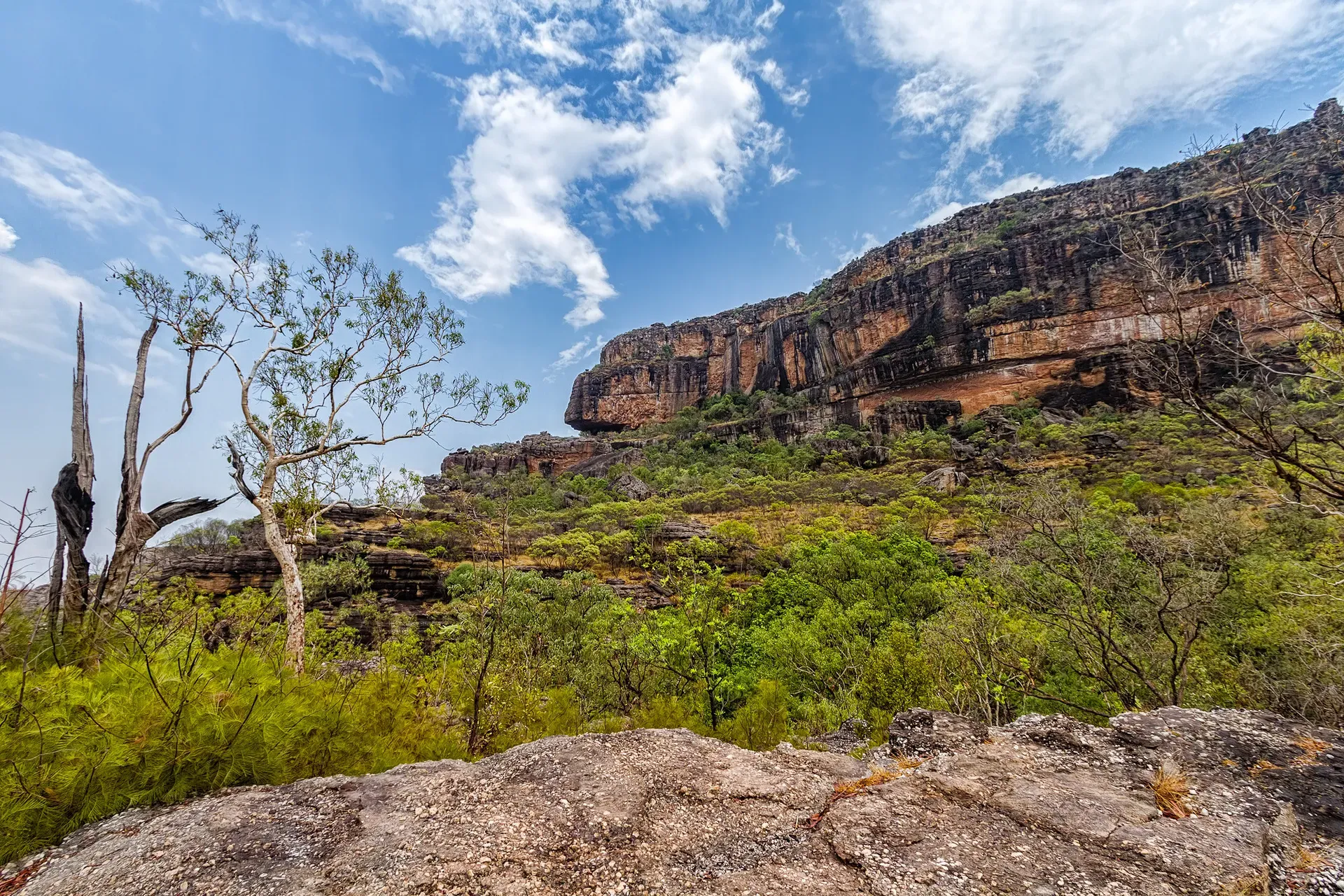
Ubirr pairs its rock art galleries with short-eared rock wallabies working the sandstone outcrops below the lookout, and the sweeping view over the Nadab floodplain at sunset often takes in distant buffalo and waterbirds too. Burrungkuy (Nourlangie) is the better bet for wallaroos, with rock pigeons common around the escarpment base. A scenic flight over the wetlands shows the scale of the floodplain in one hit, though nothing beats a boat for close-up animal encounters.
Cahills Crossing
The East Alligator River causeway is the park's reliable crocodile show, best an hour either side of a rising tide when barramundi and crocodiles feed together at the crossing. Watch from the viewing platform, not the causeway itself. If self-driving isn't the plan, day tours from Darwin cover Yellow Water, Ubirr and Cahills Crossing without the logistics.
Dry Season vs Wet Season
Dry season, roughly May to October, is the easiest time to see animals. Waterholes shrink, wildlife concentrates around what's left, and every road and cruise is running; late in the dry, August to October, is peak viewing. The wet season, November to April, floods close to a third of the park and shuts down Jim Jim and Twin Falls, but it also brings migratory birds and breeding plumage — Yellow Water and Burrungkuy generally stay open regardless. A standard park pass covers 7 days, plenty for a cruise and both rock art walks; check current pricing and validity on our opening hours and entry fees page before you go.
Timing It by Species
Sightings vary through the day too. Saltwater crocodiles and agile wallabies are most active around 7am, while magpie geese and white-bellied sea-eagles peak closer to 5pm. Plan your cruise or walk around whichever species tops your list.
Staying Safe Around Kakadu's Wildlife
Kakadu's wildlife rules are short, and every one exists because someone got hurt ignoring it.
- Never approach, feed or swim near water where crocodiles might be present, even without a warning sign.
- Stay inside vehicles when directed, and never stop in a traffic lane to photograph an animal.
- Treat every snake as venomous and give it a wide path.
- Keep well clear of water buffalo and feral pigs; both can charge with no warning.
- Follow ranger signage and site closures without exception.
None of this should keep you off the water or the trails. It's exactly why the guided cruises and raised viewing platforms exist, putting you close enough to watch without putting you at risk.
Frequently asked questions
What is the most dangerous animal in Kakadu National Park?
The saltwater crocodile, which can exceed 6 metres and 1,000kg and has killed people in the park's waterways. Venomous snakes such as the northern death adder are also a serious risk if disturbed.
Will I definitely see a crocodile in Kakadu?
Very likely on a Yellow Water Billabong cruise or at Cahills Crossing, where crocodiles are common. Spotting one from a random riverbank is far less certain, and you should never go looking for one at the water's edge.
What is the best time of year to see animals in Kakadu?
Late dry season, roughly August to October, when shrinking billabongs concentrate wildlife and make sightings easiest. The wet season (November-April) brings migratory birds and breeding plumage but floods some access roads.
Are there wallabies in Kakadu?
Yes. Agile wallabies are the most commonly seen mammal in the park, and antilopine and black wallaroos plus short-eared rock wallabies live around rocky outcrops at Ubirr and Burrungkuy.
How many species of animals live in Kakadu National Park?
Roughly 60-plus mammal species, 280-plus birds, 117 reptiles and 25 frog species, based on Parks Australia's own species counts.
Can you swim in Kakadu because of crocodiles?
Only at a small number of ranger-designated safe swimming spots that are checked and signed. Most billabongs and rivers can hold saltwater crocodiles, and swimming there is dangerous and often against park rules.
What is the rarest animal in Kakadu?
Leichhardt's grasshopper is about as localized as it gets, found almost nowhere outside Kakadu and western Arnhem Land's sandstone country. Mitchell's water monitor (critically endangered) and the Gouldian finch (endangered) are also among the park's rarest sightings.
Where is the best place to see wildlife in Kakadu?
Yellow Water Billabong, for the combination of crocodiles and waterbirds from a cruise boat. Ubirr and Burrungkuy are the best bets for wallabies and wallaroos.