Kakadu National Park spreads across almost 20,000 square kilometres between Darwin and Arnhem Land, and nobody sees all of it in one trip. Rock art galleries up to 20,000 years old sit a short drive from crocodile-filled billabongs and waterfalls that only run half the year. Deciding what to skip is harder than finding something to do.
This guide starts with the practical decisions — pass, season, access — that shape everything else, then works through the rock art, cruises, waterfalls and cultural stops worth building a route around. It closes with region-based itineraries for three and five days, so you're not backtracking across the park to tick things off a list.
Kakadu Essentials: Passes, Access & When to Go
Every non-resident visitor needs a park pass, and it isn't the same pass used at Litchfield or Nitmiluk down the road — Kakadu sits under separate federal management through Parks Australia, so an NT Parks Visitor Pass won't get you through the gate. A 7-day pass costs $40 for adults, $20 for children and $100 for a family of four in the dry season (15 May–31 October), dropping to $25, $12.50 and $65 from 1 November to 14 May. Buy online at book.parksaustralia.gov.au before you arrive, or pick one up at Bowali Visitor Centre; see opening hours and entry fees for concession rates and current details.
Darwin is the usual starting point, about 250km and a three-hour drive down the sealed Stuart and Arnhem Highways. A 2WD covers Ubirr, Burrungkuy and Yellow Water without trouble; step up to a 4WD if waterfalls and gorges are on the list, and see how to get to Kakadu for the full route breakdown. Self-driving means you control timing, worth it for a sunrise cruise, while day tours from Darwin suit anyone who'd rather not drive a 4WD track after dark.
Most visitors plan around seven loose regions rather than one long loop:
- South Alligator — the entry corridor, home to Mamukala Wetlands
- Jabiru — the park's only town, with fuel and Bowali Visitor Centre
- East Alligator/Erre — Ubirr and Cahills Crossing
- Burrungkuy/Nourlangie — the main rock art complex
- Yellow Water/Cooinda — the billabong cruise hub
- Jim Jim/Twin Falls — 4WD waterfall country
- Mary River — Gunlom and Maguk, in the park's south
Time it for the dry season, May to October, when every road and waterfall is open and the heat is bearable for walking. June to August is peak — book cruises and accommodation ahead. Wet season travel (November–April) trades waterfall access for thinner crowds and dramatic skies, but expect a third of the park underwater and every 4WD track shut.
Ancient Rock Art & Escarpment Lookouts
Kakadu holds more than 5,000 recorded rock art sites, part of one of the longest continuous historical records on the planet. Four of them account for most of a first-timer's time: Ubirr, Burrungkuy, Nawurlandja and Nanguluwurr, each a different kind of stop.
Ubirr
Ubirr is the rock art site everyone means when they mention 'the paintings' at Kakadu. A flat, mostly shaded loop of about a kilometre passes galleries of X-ray style art — barramundi, wallabies, long-necked turtles — some dated to 20,000 years old. The main lookout is a short rock scramble beyond the galleries, opening onto a 360-degree view over the Nadab floodplain that ranks among the best sunset spots in the Top End.
Arrive at least 45 minutes before sunset in the dry season; the car park fills and the lookout gets crowded fast once the light turns gold. Alcohol is banned here out of respect for the site's cultural significance.
Burrungkuy (Nourlangie)
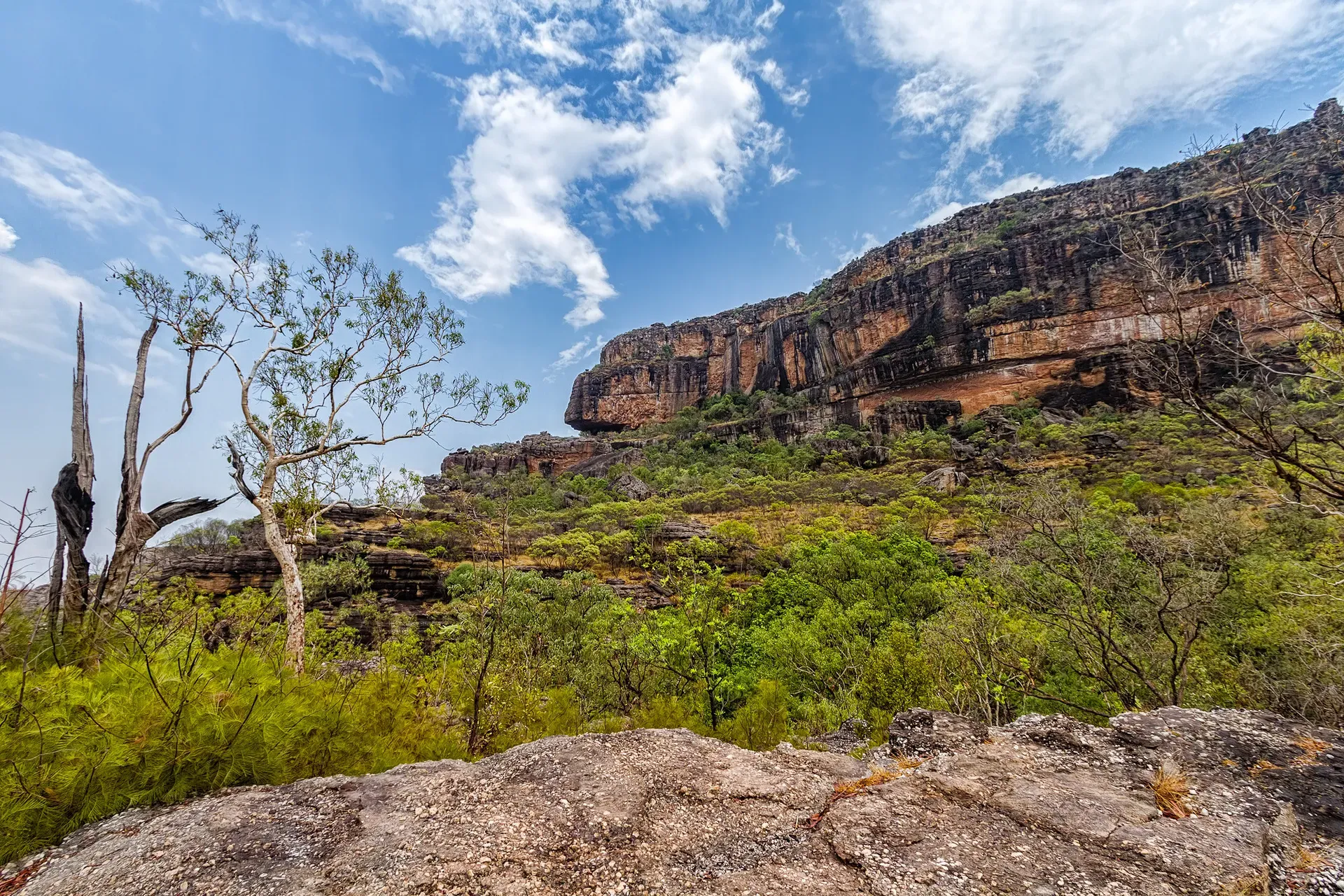
Burrungkuy, still commonly signed as Nourlangie, groups several galleries under one sandstone overhang a short walk from the car park. The standout is the Anbangbang Gallery, where Namarrgon the Lightning Man strides across the rock, stone axes at his head, elbows and knees, connecting cloud to ground. The loop is under a kilometre and largely shaded, a good midday stop when Ubirr feels too exposed. A side track climbs to Gunwarrdehwardhe Lookout for views across the escarpment into Arnhem Land — steeper and rockier, but only about 20 minutes extra.
Nawurlandja Lookout
Nawurlandja sits across the road from Burrungkuy and draws a fraction of Ubirr's sunset crowd. The climb is short, steep and shadeless over bare rock, but it delivers a wide view over Anbangbang Billabong and the escarpment without the jostling. Good backup if Ubirr's already ticked off, or an easy way to dodge the crowds.
Nanguluwurr
Nanguluwurr is the gallery most visitors skip, which is exactly its appeal. The walk in is quiet, and the art includes a painting of a European sailing ship made after first contact, alongside older traditional figures nearby. Free ranger-guided walks and talks run at several rock art sites through the dry season, included with your park pass — worth checking the schedule at Bowali when you arrive.
Wildlife Cruises, Croc-Spotting & Birdwatching
Water is where Kakadu's wildlife concentrates, and where most of the best sightings happen. More than 10,000 crocodiles live in the park's rivers and billabongs — narrow-snouted freshwater crocodiles that generally leave people alone, and the far more dangerous saltwater crocodiles behind every swimming restriction in this guide. Add close to 280 recorded bird species and our wildlife-spotting guide is worth a read before you go.
Yellow Water Cruise
The Yellow Water Cruise is Kakadu's signature wildlife experience. Boats spend about 1.5 hours weaving through the billabong and onto the South Alligator River, past crocodiles basking on the banks and jabiru storks working the shallows; around 60 bird species turn up on a typical run. Book the sunrise or sunset Yellow Water Cruise departure — mist rises off the water at dawn, and both slots sell out first through June to August.
Guluyambi Cultural Cruise
The Guluyambi Cultural Cruise runs a different river and a different story. It covers the East Alligator, guided by Traditional Owners, and the hour-long trip includes a stop on the Arnhem Land bank — off-limits any other way without a permit — where guides demonstrate traditional tools and hunting methods. Pair it with Yellow Water rather than instead of it.
Cahills Crossing
Cahills Crossing, on the East Alligator River, is where Kakadu's crocodile reputation gets confirmed in person. Barramundi wash over the causeway on the incoming tide and crocodiles gather to feed, sometimes several in view at once. High tide is the best window — check tide times first — and dry-season evenings often bring a ranger giving an informal talk from the safe side of the fence. Never walk out onto the crossing; vehicles have been swept off it.
Mamukala Wetlands
Mamukala trades crocodiles for feathers. A flat, wheelchair-accessible boardwalk loops through paperbark forest to a hide overlooking floodplains that hold tens of thousands of magpie geese by late dry season. No boat ticket needed, and the shaded walk is one of the few that works in the middle of a hot day.
Barramundi fishing is legal on parts of the South Alligator River and Yellow Water outside the cruise zone, with licensed guides running trips out of Cooinda. Stay in the boat and land fish quickly — crocodiles are never far off.
Waterfalls & Swimming Holes
Kakadu's waterfalls sit in the park's south and east, and getting to most of them is half the adventure. Access swings hard with the seasons, so treat every plan below as provisional until you've checked the current status.
Jim Jim Falls
Jim Jim Falls drops about 200 metres off the escarpment, the tallest in Kakadu, into a plunge pool ringed by sheer cliffs. Getting there means a 4WD track followed by a boulder-hop hike, and the pool only opens once rangers confirm it's free of crocodiles, generally from around July. The whole Jim Jim and Twin Falls area, including Karnamarr campground, is closed for the 2026 season — check the Kakadu Access Report before planning a day around it.
Twin Falls
Twin Falls sits a short drive from Jim Jim and shares its access problems, with an even shorter open window. When it's running, reaching the base can mean a shuttle or short boat trip across the gorge, ending at a waterfall landing on a white sand beach backed by monsoon rainforest. Confirm current access before committing a day to it — same rule as Jim Jim.
Gunlom Falls
Gunlom has two personalities. The lower pool and picnic area sit a five-minute walk from the car park, easy for most fitness levels. The upper pools — the infinity-edge plunge made famous in Crocodile Dundee — need a steep climb over loose rock, hot and exposed, but worth it for the view over the plains. Go early to beat the heat and the crowd at the top.
Maguk (Barramundi Gorge)
Maguk needs a 4WD to reach and a rock-scramble to finish. The walk in follows a monsoon-forest creek before opening onto a deep, sheltered swimming hole under a low waterfall. There's a bush campsite on site but no toilets at the swimming area, so plan accordingly. Quieter than Gunlom, and prettier at midday when the light drops straight into the pool.
Motor Car Falls
Motor Car Falls suits anyone chasing a swimming hole without the crowds at Gunlom or Maguk. It's a 7.5km return walk through lightly-trafficked bushland to a smaller, calmer pool — a half-day outing, not a quick stop, and a solid backup when the bigger names are closed or booked out.
None of these swimming holes open on a fixed date. Rangers survey each one for crocodiles before declaring it safe, and a single sighting can shut a site for days. Check the access report the morning you go, not the night before.
Culture Beyond the Rock Art: Centres, Art & Ranger Talks
The paintings only tell half the story. Kakadu's cultural centres and ranger programs explain the systems behind them, and more than half the park remains Aboriginal land, jointly managed with Parks Australia.
Warradjan Aboriginal Cultural Centre
The Warradjan Aboriginal Cultural Centre, near Cooinda, is where the rock art gets context. Exhibits laid out around a turtle-shaped building cover the Bininj/Mungguy moiety system, the six-season calendar used to track food and weather, and the more recent history of uranium mining in the region. Give it 45 minutes; it's the best single stop for understanding what you've just seen at Ubirr and Burrungkuy.
Bowali Visitor Centre
Bowali Visitor Centre, near Jabiru, deserves to be the first stop on any trip. It's air-conditioned, sells park passes, and staff can tell you same-day what's open and what's flooded. Read our Kakadu National Park visitor guide for the wider history and highlights before you set out.
Injalak Arts Centre
Injalak Arts Centre sits an hour east in Gunbalanya, across the East Alligator River in West Arnhem Land, and needs a permit to visit — arrange it through the centre or a tour operator in advance. Running since 1989, it represents more than 200 local artists working in bark painting, weaving and screen-printing, with sales going directly back to the community.
Ranger-Guided Talks and Seasonal Events
Free ranger-guided walks, talks and demonstrations run daily through the dry season, covering bush foods, weaving and didgeridoo-making, all included with your park pass. If your dates line up, the Taste of Kakadu festival adds traditional hangi-style cooking and bush food demonstrations to the calendar; it's seasonal and not guaranteed every trip, but worth checking the events listings if you're travelling in the cooler months.
Scenic Flights & Off-the-Beaten-Path Adventures
A scenic flight solves the problem every wet-season visitor runs into: the best waterfalls are closed to cars but still running at full volume. Fixed-wing and helicopter flights out of Jabiru or Cooinda run in 30- or 60-minute options, tracing the escarpment and putting Jim Jim and Twin Falls in view even when the ground road is shut. Compare scenic flight tours — it's the one Kakadu experience that doesn't care what season it is.
Barrk Walk
Fit walkers can extend the Burrungkuy stop into the Barrk walk, a difficult 12km loop that circles back through stone country to link up with the Nanguluwurr art site. Carry more water than feels necessary and start before 8am — there's no shortcut once you're committed.
Yurmikmik Walks
The Yurmikmik walks, in the park's south near Gunlom, range from an easy hour-long circuit to a full-day route past old tin-mining relics and swimming spots that see almost no one else. A good pick for a second or third Kakadu trip, once the headline sites are done.
Boating and fishing away from the main routes — the upper South Alligator River, Jim Jim Billabong, Home Billabong — reward travellers with their own boat or a private guide, and the crowds thin fast once you're past Cooinda.
Sample Itineraries & Practical Trip Tips
How much of the above you fit in comes down to how many days you have and whether you're driving yourself. Here's how to sequence it by trip length.
One-Day Loop from Darwin
A single day from Darwin is tight but doable on a tour rather than a self-drive — allow three hours each way and you're left with maybe six hours in the park. Most single-day tours combine Ubirr's rock art and floodplain lookout with a Yellow Water cruise, skipping the 4WD-only waterfalls entirely. Book a multi-day trip instead if Jim Jim or Gunlom matter to you; browse Kakadu tours to compare options.
Three-Day Itinerary
Three days is the minimum for the highlights without rushing. Day one: drive from Darwin, stop at Bowali for your pass, then Ubirr for sunset. Day two: Burrungkuy and Nawurlandja in the morning, Warradjan Cultural Centre through the midday heat, Yellow Water cruise at sunset from Cooinda. Day three: Gunlom or Maguk on the way back south. Grouping the days this way — East Alligator, then Yellow Water/Cooinda, then Mary River — keeps backtracking to a minimum.
Five-Day Itinerary
Five days adds the 4WD country. Build in a full day for Jim Jim Falls (the boulder-hop hike takes longer than it looks), a half-day at Twin Falls if it's open, and a second night near Cooinda so the Yellow Water cruise doesn't feel rushed. Check the access report before locking in Jim Jim and Twin Falls; the 2026 closure of that whole area is a reminder to verify rather than assume.
Safety & Logistics
A handful of details separate a smooth trip from a stressful one:
- Swim only at signed, ranger-declared safe sites — crocodiles use every other waterway.
- Mobile reception works reliably in Jabiru only, and is patchy at best at Cooinda Lodge.
- Fuel up at Jabiru or Cooinda; there's nowhere else to buy it inside the park.
- Carry at least a litre of water per person per hour on any walk.
- Check the Kakadu Access Report each morning before heading to a 4WD site.
| Site | Vehicle Needed | Notes |
|---|---|---|
| Ubirr | 2WD | Sealed road, flat walk to galleries |
| Burrungkuy / Yellow Water | 2WD | Sealed roads throughout |
| Gunlom | 4WD | Unsealed access road |
| Maguk | 4WD | High-clearance recommended |
| Jim Jim Falls | 4WD | Dry season only; closed for 2026 |
| Twin Falls | 4WD | Dry season only, shorter window than Jim Jim |
Where to Stay and Eat
Jabiru is the park's only town, with a supermarket, fuel and the most reliable phone signal in the park. Cooinda Lodge, near Yellow Water, is the closest base to the cruise departure point. Gunlom and Maguk both have bush campgrounds if you want to stay near the waterfalls; pack insect repellent and sun protection wherever you sleep.
Frequently Asked Questions
How many days do you need in Kakadu National Park?
Most visitors spend 2-3 days covering Ubirr, Burrungkuy and a Yellow Water cruise. Add Jim Jim Falls, Twin Falls, Maguk and Gunlom and you're looking at 4-5 days minimum.
Are there crocodiles in Kakadu National Park?
Yes — more than 10,000 of them, both freshwater and saltwater, live in the park's rivers and billabongs. Cahills Crossing and the Yellow Water Cruise are the most reliable places to see one.
Do I need a 4WD to visit Kakadu?
Not for the main sites. Ubirr, Burrungkuy, Yellow Water and Bowali all sit on sealed roads reachable by 2WD. Jim Jim Falls, Twin Falls, Maguk and the Gunlom access road all require a 4WD.
Can I visit Kakadu in the wet season?
Yes, though most 4WD-only sites, including Jim Jim, Twin Falls and Maguk, close due to flooding between November and April. Ubirr, Burrungkuy, Yellow Water and scenic flights stay open and are the best wet-season picks.
Is Kakadu better than Litchfield National Park?
They do different jobs. Litchfield, closer to Darwin, has easier and more reliably open swimming holes for a quick trip. Kakadu is larger, more remote, and stronger on Indigenous culture, rock art and scale — pick it if you've got more than a day to spend.
What does it cost to enter Kakadu National Park?
A 7-day pass costs $40 for adults, $20 for children and $100 for a family in the dry season (15 May–31 October), dropping to $25, $12.50 and $65 in tropical summer (1 November–14 May).
Is Jim Jim Falls currently open?
Access changes year to year. As of the 2026 season, the Jim Jim and Twin Falls area, including Karnamarr campground, is closed — check the Kakadu Access Report at kakadu.gov.au before planning a day around it.
What is the best time of year to visit Kakadu?
The dry season, May to October, gives the most reliable access to waterfalls and 4WD tracks, with June–August as the busiest stretch. Shoulder months and the wet season suit travelers chasing birdlife, waterfall volume by scenic flight, and thinner crowds.